
Thursday, June 8, 2023
Join me online at Arise Festival tomorrow!
Really looking forward to talking about Sylvia Pankhurst tomorrow. Details of how to join the discussion below:


Saturday, May 20, 2023
On Annie Cobden-Sanderson and Sylvia Pankhurst's radical American modernism: a photo essay
This is the transcript of a paper I was lucky enough to be able to present at the Transatlantic Women's Networks Conference: Cultural Engagements from the 19th Century to the Present conference, held at Lisbon's Universidade Católica Portuguesa on Thursday 11 May.Thank you to the organisers and the other participants for such a stimulating day.
The paper is about two suffragettes: Annie Cobden-Sanderson and Sylvia Pankhurst. They were from different generations, Annie Cobden-Sanderson was born in 1853, Sylvia Pankhurst in 1882, but they knew each other and were imprisoned together in 1906. They both toured America, separately, and wrote about their reflections which is what I discuss here. Both women were socialists, influenced by the Arts and Crafts movement, and both were uneasy with the political direction of the dominant suffragette organisation, the Women's Social and Political Union. I argue that interesting parallels can be detected in their writing.
My paper, supported by photographs I took whilst researching Sylvia Pankhurst's American lecture tours, is below as a sort of photo essay. This is something I've wanted to write for ages and I hope it's an enjoyable read.
Direction of travel? Retracing the footsteps of two militant suffragettes across the Atlantic
By Katherine Connelly
In February
1913, on the eve of launching a militant, working-class suffragette campaign in
East London, Sylvia Pankhurst reflected on her two lecture tours of America,
undertaken in the first three months of 1911 and again in the first three
months of 1912. Pankhurst’s American manuscript is arguably one of her most
experimental – a contrast to the style employed in her published histories (The
Suffragette, in 1911, and The Suffragette Movement, in 1931)
– it juxtaposed empirical studies of working conditions, with a dream-like
evocation of a children’s performance of Sleeping Beauty in which
youngsters from New York’s tenements danced as flowers in an allegory for the
awakening spring. There was a transcription of a desperate letter from an
immigrant prisoner, with descriptions of the fleeting landscape outside the
train window – the latter a legacy of part of the book’s origins in letters
written whilst travelling (of which more later).
Pankhurst began her book on America, which she
never completed and which was not published until 2019, with New York City, her
point of arrival. She described the ‘grey’ and ‘dreary’ harbour ‘with its huge
buildings, heavy, gloomy and intensely ugly, wrapped in a withering sullen cold
without, and all breathless heat and glaring jarring lights and noise within’.
But then the light changes: ‘I saw it translated by the brilliant sun,
everything a-sparkle, everywhere crowding vivacious life.’ And then as the sun
dips below the horizon, the light changes again and now -
How wonderful is New York from some high place at twilight, when the lofty buildings of commerce are fading into obscurity, and one sees, not their giant walls, faint and shadowy, but their thousand thousand windows like jewels of fire. Their golden patterning and the blue fading light cast a compelling glamour over this city of substantial and materialistic trade. It becomes ethereal as a city of dreams, beautiful and calm as the home of supermen.
 |
| New York City, 2017. Photo: K. Connelly |
In the very next
paragraph, the beautiful metaphor of fiery windows in skyscrapers transmogrifies
into a ghastly reality as Pankhurst recalls walking in the funeral procession
for the victims of the Triangle Fire – 146 workers, mostly women, mostly
immigrants, who died after a fire broke out in the Triangle Shirtwaist factory
in New York’s Greenwich Village. Their employers had illegally locked the doors
on the workshop floor – to prevent workers’ stealing, it was said – and so the
workers were trapped, the fire department did not have ladders tall enough to
reach the factory floors which were at the top of the building.
For Sylvia, the
Triangle fire epitomised a struggle she witnessed throughout her tours. She
observed that
‘As one travels over that vast continent of America, teeming with wondrous natural resources, with endless possibilities of new growth, one sees, as in our older and more crowded land, everywhere the cruel waste of precious human energy, and the crushing out of fragile tender things. One sees, perhaps more clearly than in any other country, new ideals of civilization striving with the old. The sharp impersonal pitiless commercial enterprise, that everywhere crushes out the slothful inexactitudes and rough spasmodic kindlinesses and brutalities of the past, and would in its turn make the human beings that it uses ever more machine-like, one now sees faced with the new up-springing of public thought and action, that shall place higher than all else the happiness and development of human lives.’
 |
| New York City, 2017. Photo: K. Connelly |
Five years
earlier, another British militant suffragette, Annie Cobden-Sanderson,
published in the American Independent magazine her impressions of
America from her own three month tour in the winter of 1907-8. Cobden-Sanderson
did not arrive into New York – as a former inmate of Holloway prison, she was
worried she would be turned away as an undesirable alien – so she entered the
country via Canada. But Cobden-Sanderson, like Pankhurst, chose to begin her
account with New York City, from where she departed. Her memories are
interlaced with the vanishing vista of the city and the progress of the voyage
in a piece that seemed to capture the speed of the modern ocean liner (she
travelled home on the Lusitania) and – perhaps – the experience of
recollection itself.
Like Pankhurst,
Cobden-Sanderson described the changing light in New York. Her final day in the
city began on a ‘cold, clear’ January morning, speaking outdoors in Madison
Square before visiting the Stock Exchange and then, in an eerie parallel that
cannot be described as exactly coincidental, she remembered a fire:
‘At night I stood watching with a friend in Union Square watching the
blazing of the latest great fire in New York. Far above the reach of the
engines the flames leapt on high, and onto the roof had clambered the inmates’.
3 firefighters
lost their lives that night.
Cobden-Sanderson’s
conclusions anticipated Pankhurst’s – she wrote of the contrasts: the
‘greatness of the country,’ ‘vastness of its problems’, in ‘the striving for
material bigness and prosperity, the absence of all mystery’.
Like the Marx
Avelings before them, America seemed to recall to Cobden-Sanderson and
Pankhurst Marx and Engels’ Communist Manifesto wherein the emergent
industrial capitalism of the mid-nineteenth century was described as sweeping
away ‘all fixed, fast-frozen relations,’ ‘ancient and venerable prejudices and
opinions’, profaning all that was holy. These later generations of socialists
found the voyage to America almost akin to travelling into the future, with
America occupying the pioneering role that Europe had in the 1840s. The
striking modernist tropes in Cobden-Sanderson and Pankhurst’s writings seems to
me an attempt to reflect that in their prose.
Pankhurst and
Cobden-Sanderson seemed to be concerned with a question posed by H. G. Wells, a
contemporary socialist and writer who imagined voyages to the future. In Wells’
1906 book of essays concerning his own transatlantic journey, titled The
Future in America: A Search After Realities and which Cobden-Sanderson read
in prison the year before her lecture tour, Wells asked “What is going to
happen to the United States of America in the next thirty years or so?”
Cobden-Sanderson asked herself if America had realised the ‘dreams of human
exaltation’ held by her father, the famous Liberal champion Richard Cobden,
when he visited America seven decades earlier.
You might ask if
there is anything particularly notable about Cobden-Sanderson and Pankhurst’s
strikingly similar responses to America: their writings are seemingly compatible
with and referential to those theirs contemporary socialists. After all both
women were adherents of an Arts and Crafts-influenced socialism in which
visions of the future were indebted to William Morris’ imagined utopian London
in his 1890 novel News from Nowhere. Cobden-Sanderson and her husband,
the Arts and Crafts bookbinder T J Cobden-Sanderson, were intimate friends,
artistic collaborators and neighbours to the Morris family. Sylvia Pankhurst’s
parents were friendly with Morris who shaped Sylvia’s decision to train as an
artist. He remained a political reference point throughout her life. I suggest,
however, that it is precisely the centrality of the socialist concerns in their
American writings that reveal the role these tours played in the development of
a radical critique of the British militant suffragette movement – the very
movement for which they were public advocates.
Retracing the
American footsteps of Cobden-Sanderson and Pankhurst reveals the extent of
their political wandering from the path expected by the autocratic leadership
of the Women’s Social and Political Union (WSPU), the dominant militant
organisation. The prototype for the militant suffragette lecture tour was
established by the three tours of WSPU leader (and Sylvia’s mother) Emmeline
Pankhurst. Arranged by a professional lecturing agency, they intended to
galvanise international sympathy for the British suffragettes and increase
pressure on the British government. In order to achieve these objectives,
Emmeline Pankhurst did not ask her audiences to approve per se of controversial
militant tactics, instead she contextualised them as legitimate responses to
specifically British conditions of political oppression - the stirring
descriptions of which (police brutality, imprisonments and forcible feeding)
drew in large crowds. This iteration of the militant suffrage struggle implied
the progressive superiority of the United States – something Emmeline Pankhurst
played up to by comparing the contemporary militants’ demands and methods to
those of the American Revolution (safely confined to that nation’s past).
Cobden-Sanderson
and Sylvia Pankhurst’s footsteps strayed far beyond the contours of the WSPU’s
political objectives. Cobden-Sanderson, in fact, was not a member of the WSPU
when she travelled to the US, having just resigned from the organisation,
objecting to its jettisoning of its socialist roots. Although officially it was
her husband who was on tour, lecturing on bookbinding, Annie Cobden-Sanderson
was invited to speak about her experiences as a high-profile suffragette
prisoner, when she had been a WSPU member. She therefore appeared to American
audiences as a representative of that organisation. Yet her tour was enmeshed
within an Arts and Crafts network which took in, for example, Hull House – Jane
Addams’ Chicago Settlement House where T. J. Cobden-Sanderson’s former student
Ellen Gates Starr was practising and teaching Arts and Crafts bookbinding.
Moreover, Gates Starr shared the Cobden-Sanderson’s appraisal of the importance
of organising among working women, she was an active member of the Women’s
Trade Union League. The concerns of Arts and Crafts practitioners with the
conditions of capitalist production found expression in Cobden-Sanderson’s American
reflections which addressed not only women’s conditions but those of all
workers; she observed, for example, that in mining towns ‘men work in misery
and filth, and are killed and maimed by unprotected machinery, and a
money-influenced and dependent judiciary refuses compensation.’ She also
identified the continuance of old oppressions, fought against by previous
reformers like her father, re-emergent in the quest for profits in the present.
She referred to the cotton plantations in Mississippi as perpetuating a
‘semi-slavery’.
Sylvia Pankhurst similarly deviated from the WSPU leadership’s politics, even though she was lecturing as their official representative. Like Cobden-Sanderson, she was enchanted by the Arts and Crafts inspired practitioners at Hull House in Chicago and Henry Street Settlement in New York. Her writings on America developed far more from her writings for socialists than for suffragists. Her book drew heavily on letters she wrote to her lover, the Labour MP Keir Hardie and articles she wrote for his South Wales based newspaper, The Pioneer, under a pseudonym. In 1912, she quite literally deviated from the expected path, taking control from the professional agency who failed to secure sufficient bookings and travelling instead to the American South where other lecturers, including her mother, had not ventured. She subsequently wrote harrowingly about legacy of slavery in the racism she witnessed in the workplaces and prisons during the era of Jim Crow.
 |
| The slave huts Sylvia Pankhurst saw at Andrew Jackson's Hermitage, Nashville, Tennessee in 1912. Photo: K. Connelly, 2018. |
Like
Cobden-Sanderson, Pankhurst was interested in conditions of production. She
wrote about the ‘model’ laundries, where the influence of Taylorism reduced the
worker to monotonous, repetitive tasks. She also wrote about Haskell, a college
for Native Americans where she observed the deliberate destruction of students’
capacity for indigenous cultural production, replaced instead by training for
integration into factory work. She lamented seeing ‘floral patterns, exactly
like those which are designed, in the least possible time, by the jaded sweated
factory wage slaves, who cannot pause to observe real flowers’. What a contrast
to the celebration of the natural world she witnessed in the children’s
performance of Sleeping Beauty!
It is important to note that institutions like the model laundries and Haskell college were presented to Pankhurst as examples of progressive, modern America. Pankhurst and Cobden-Sanderson’s defiant adherence to socialist politics, informed by the culture of the Arts and Crafts movement, ensured that their engagement with America was one which destabilised the notions of progress held by many American progressives as well as the WSPU. In so doing, they emphasised solidarity with American activists and identified commonalities in their respective struggles across national boundaries. In response to Wells’ question, they seemed to have two answers, reflective of the dynamic processes to which they were witness.
 |
| "Rise Up!" Graffiti at the site of the Triangle fire. Photo: K. Connelly, 2017. |
America had both the resources and productive capacity to build an inhuman society organised around gargantuan profits and skyscrapers crammed full of sweated workers, or it could establish an egalitarian society of fellowship in which all enjoyed the country’s seemingly endless resources. Which one would triumph? ‘Kaleidoscopic you move in crowds’ wrote Cobden-Sanderson of America. The kaleidoscope turns, the light changes, which way? The answer, both resolved, would be determined dynamically – in struggle. After America, neither Cobden-Sanderson nor Pankhurst confined themselves to the question of women’s suffrage as defined by the WSPU. Cobden-Sanderson joined the Women’s Freedom League, taking up a multitude of causes including that of feeding poor children in East London. On her return from America in 1912, Sylvia Pankhurst began organising WSPU groups also in working-class East London, which were expelled from the WSPU after co-operating with the labour movement. Pankhurst’s collaborator in this endeavour was Zelie Emerson, a member of the Women’s Trade Union League she had met whilst on tour in Chicago. That direction of travel, I think, can partly be mapped in America.
Wednesday, April 12, 2023
Podcast: Sylvia Pankhurst and the real history of International Women's Day

It was a pleasure to speak with American comrades about the real history of International Women's Day, established to celebrate and foster the anti-capitalist struggle of working-class women, and what's wrong with the corporate co-option of the day.
In this podcast, I spoke with Cyril Mychalejko from The Signal podcast at the 'Bucks County Beacon' about that history and Sylvia Pankhurst in America - including, of course, her participation in the International Women's Day march in Boston in 1911!
You can listen here.
Monday, March 6, 2023
Upcoming talks to celebrate International Women's Day!
Really excited to be able to announce that I'm going to be joining what look like fantastic panels around this year's International Women's Day.
 |
East London Federation of Suffragettes member, Annie Lake, speaking with strikers at Morton's factory, 1914. |
On Tuesday 7th March, I'm going to be talking about the East London Federation of Suffragettes at the Cockney Cultures event 'Cockney Women Together'. I'll be joined by Kim Bennett, the Pearly Queen of Woolwich, Louise Raw, author of Striking a Light, the definitive account of the 1888 matchwomen's strike, Sam Johnson, great-granddaughter of Sarah Chapman, one of those striking matchwomen, and artist Sba Shaikh.
It's taking place from 12.30-13.30 at Four Communications Group 2 Whitechapel Road London E1 1FX and you can book a free place here.
Then on Thursday I'm travelling up to Salford to the wonderful Working-Class Movement Library for the 'Radical Motherhood: Then and Now' conference where I'll be joining a roundtable discussion exploring the ways that mothers have engaged in and reshaped radical movements, from the suffragettes to ACT-UP and beyond.
I'll be talking about the schemes that Sylvia Pankhurst set up to support working-class mums during the First World War, and tracing their origins in industrial struggle. Very excited to hear from the other panelists. The Eventbrite page explains:
Dr J. Michelle Coghlan (UofM) will kick off our discussion by turning to nineteenth-century US women anarchist activists who challenged conventional forms of motherhood in ways that continue to resonate in our own moment.
Dr. Katherine Connelly (Arcadia) will then discuss the free nurseries that Sylvia Pankhurst established in East London, and offer some personal reflections on balancing motherhood and contemporary community organizing.
Dr. Nicholas Grant (UEA) will turn our attentions to South African anti-apartheid activist Dora Tamana and her travels to the World Congress of Mothers in Switzerland in 1955, showcasing how Tamana’s embodied activism was crucially rooted in her framing of herself as a mother.
And, finally, Dr. Monica Pearl will close our panel with a discussion of the politics of motherhood in AIDS activism, both in relation to women’s AIDS memoirs and Dr. Pearl’s own experiences as an ACT-UP activist in the 1980s, before we open the floor for further conversation with the audience.
This one's sold out now, but I believe that it might be recorded so I'll be sure to post details after the event.
Whilst in the North-West I'm going to be doing some research for my new book, a project that developed out of A Suffragette in America. For more updates . . . watch this space!
Review of 'Between Two Fires': the play Sylvia wrote in prison
Yesterday I posted my review of Sylvia, a musical currently playing at The Old Vic, about the life of Sylvia Pankhurst.
But there's more theatre news about Sylvia! Recently, Rachel Holmes, author of a magnificent new biography of Pankhurst, has painstakingly reconstructed and published the play Sylvia wrote on scraps of toilet paper whilst in prison. Below is my review, first published on Counterfire.

Sylvia Pankhurst, Between Two Fires, arranged and edited by Rachel Holmes, introduction by Helen Pankhurst (London: Methuen Drama, 2022), 41pp.
Sylvia Pankhurst’s long-lost play carries a powerful message about fighting oppression, argues Katherine Connelly
Toilet-paper transcripts
In 1921, former suffragette Sylvia Pankhurst was imprisoned one final time. By now a prominent communist, her newspaper the Workers’ Dreadnought called for working-class resistance to growing unemployment, impoverishment and racism. The authorities used wartime legislation that had not been repealed to imprison Pankhurst in Holloway for six months.
In prison, Pankhurst was denied pen and paper: the very materials with which she had terrified the establishment. In a book of poems she published after her release, titled Writ on Cold Slate, she reflected: ‘thought in prison shall be writ / save on cold slate and swiftly washed away.’
But Sylvia Pankhurst was not so easily silenced. In fact, she did something quite extraordinary: she wrote a play on toilet paper and, using tactics the suffragettes had perfected years earlier, smuggled it out of prison. Not all of it survived, but Pankhurst preserved the pieces that remained. As her granddaughter Helen has written, this shows that she ‘didn’t want them extinguished’. After her death, Sylvia Pankhurst’s son Richard deposited the fragments at the British Library. They remained there until Rachel Holmes rediscovered them when writing her monumental biography, Sylvia Pankhurst: Natural Born Rebel.
After painstaking work transcribing this most fragile of archives, Rachel Holmes has published the ‘Toilet Paper Transcripts’ and completed Sylvia Pankhurst’s act of resistance. Together they have broken through the prison bars, allowing us to hear the voice of the imprisoned Sylvia Pankhurst. The result contains exciting implications for our understanding of history and the present.
Reflecting on suffragette activism
The play shows that while in prison for communist activism, Sylvia Pankhurst was reflecting on the suffragette movement. This fact alone makes it a unique source. Before now, Pankhurst’s assessments of the suffragette movement have generally fallen into two categories. Her first book, The Suffragette (1911) was written in the midst of the struggle, but she later distanced herself from it because it largely reproduced the narrative of the movement’s leadership and suppressed her own criticisms. Her later book, The Suffragette Movement (1931), was undoubtedly Sylvia Pankhurst’s definitive account of the campaign.
The ‘Toilet Paper Transcripts’ (1921) provide Sylvia Pankhurst’s perspective on the campaign exactly between these two points, while she was intensely involved in the international communist movement. It would have been understandable if Pankhurst, in prison once again, had dramatized her own incredibly heroic role and frequent imprisonments as a suffragette in her toilet-paper play. Instead, the fragments reveal Pankhurst’s profound commitment to the importance of collective action, with scenes about community activists that drew on her experience of organising in working-class East London. As Helen Pankhurst observes: ‘for Sylvia, the addressing of envelopes and the folding of circulars, i.e. the hands-on realities of politicking and of people’s lives are given attention – not taken for granted.’
Suffragettes vs Labour
The heart of the play addresses the increasing diversion between the suffragette movement and the Labour Party. Initially, the militant suffragettes had emerged from labour circles, but over time these links were severed. The Labour Party was divided over the question of votes for women. Many were uncomfortable with the campaign because it did not address dismantling the voters’ property qualification and therefore seemed destined to exclude most working-class women. Some others supported votes for women on the basis that it challenged women’s particular exclusion. And there were also misogynists who were opposed to women’s political rights altogether.
Meanwhile, the leadership of the suffragette movement demanded the Labour Party prioritise votes for women above all other issues by voting against every measure of the Liberal government (whether progressive or not) until the government agreed to back women’s suffrage. Their growing hostility to the Labour Party accompanied their rejection of mass action in which large numbers of working women could participate, favouring instead individualistic actions by more privileged women.
Sylvia Pankhurst had intimate experience of these divisions. The militant suffragettes were led by her mother and older sister, Emmeline and Christabel Pankhurst, who eventually expelled her for organising working-class suffragettes in East London, and offering solidarity to locked-out trade unionists in Dublin. While she was active as a suffragette, Sylvia Pankhurst’s lover was Keir Hardie, Labour MP and former leader of the Labour Party. He died in 1915, six years before she wrote the play.
The play addresses the emotional pull of all these different loyalties through the relationship of Freda McLaird (Sylvia Pankhurst) and Noah Adamson (Keir Hardie). Interestingly, the one who is described as being caught ‘between two fires’ (which Rachel Holmes aptly chose as the title for the untitled play) is Adamson/Hardie rather than McLaird/Pankhurst.
It is Freda who explains to Noah that the suffragette leaders fail to see that Labour is not only ‘lukewarm at best’ on women’s suffrage, ‘but on every question’ (p.28). She refers to the ‘Anti-Guzzling League’ which Hardie had planned to stop Labour MPs ‘guzzling’ in the House of Commons bar with the Liberals.
Pankhurst, of course, was writing this in 1921 when she was arguing against the leader of the Bolshevik Revolution, Lenin, that communists should have no relationship with the Labour Party, except to denounce it as traitorous to working people. In the play, she rather awkwardly positions Adamson/Hardie as an exception who might leave Labour ‘on the fundamental question of the Class struggle’ (p.28), which was somewhat wishful thinking.
However, Freda’s complaint that many in the Parliamentary Labour Party were ‘proud of being made friends of the Liberals and Tories’ (p.29) is a valuable insight today. Faced with a Labour leader who seems far more comfortable with the Tories than the former socialist leader of his own party, some have romanticised the history of the early Labour Party. Pankhurst reminds us that the Labour Party was never a principled, socialist party, and its attacks on socialists have a long history.
Sylvia Pankhurst and Keir Hardie’s relationship
Another interesting aspect of the play is the potential insights it offers into Hardie and Pankhurst’s relationship. Hardie was married, and his relationship with Pankhurst was kept relatively private. That Pankhurst preserved their love letters and this play, which explicitly discuss the relationship, suggests she wanted it to be acknowledged as part of her life story.
Some writers on Pankhurst have patronisingly reduced her relationship to finding a ‘father figure’ (Hardie was much older, originally her parents’ friend). The relationship depicted in the play, by contrast, supports Holmes’ depiction (and before her Caroline Benn in her biography of Hardie) of Pankhurst as a partner who ‘typically holds her ground’ (Holmes, p.223).
In the play we see McLaird helping rewrite an article in Adamson’s name, which should surely now prompt a renewed look at Hardie’s writings for Pankhurst’s involvement. Adamson is portrayed as the dreamer who hopes that they might have a child, while McLaird is the realist who points out that the consequences would be practically and politically devastating. Moreover, as Holmes’ biography shows, Pankhurst was acutely aware of the difficult position in which Hardie’s wife would find herself. McLaird voices the human pain in a society rigidly organised on the institution of marriage: ‘I shouldn’t like to be the cause of making anyone else unhappy’ (p.31).
Striking resolution
What kind of resolution does Pankhurst see for those caught, like herself and Hardie, between the ‘two fires’ of the women’s and labour movement? In a compelling part of the play, Pankhurst dramatizes the kind of industrial unrest that coincided with the last four years of the suffragette movement. Pankhurst would later recall: ‘Strikes, especially of women, and some of them only lasting a few days, were breaking out on all sides of us’ (The Suffragette Movement, p.543).
This atmosphere is captured in the play as characters rush in to announce workers walking out, including the gas workers (a key industry in East London):
‘There’s five hundred out: the whole shop. Started with the manager giving one of the men the sack and spread all through the place, the girls came out as solid as the chaps. [. . .] They’ve got married men working in there for eighteen shillings a week and women as low as five’ (p.15).
Sylvia Pankhurst’s socialist conclusion is that working people can, and must, overcome the divisions sown from above when they struggle for their rights themselves. It is a conclusion that is as relevant today as it was in 1921. Let’s hope that this play will finally get the public performance it deserves, over a hundred years after it was written in secret in a British prison cell.
Sunday, March 5, 2023
Review of 'Sylvia' at The Old Vic
First published on Counterfire, I repost my review of 'Sylvia', directed by Kate Prince, written by Kate Prince with Priya Parmar, music by Josh Cohen and DJ Walde, playing at The Old Vic in London until the 8 April 2023.

Sylvia is a glorious celebration of the suffragette struggle, but it doesn’t do its heroine justice, finds Katherine Connelly
At the end of the first act, audience members were in tears they were so moved by this powerful evocation of the suffragette movement. Act One culminates with the suffragettes, arms linked, confronting horrendous levels of police violence on their demonstration outside parliament on 18 November 1910, later dubbed ‘Black Friday’.
Perhaps the scene makes you cry because all of a sudden this is not about something that happened over a hundred years ago. It looks like the police attack on the vigil for Sarah Everard, inevitably recalling the epidemic of police violence against women – the full, awful extent of which has not yet come to light. That’s what this musical does best: it proclaims the relevance of the suffragette struggle.
‘Feels like revolution’
It is a wildly ambitious performance told through dance and is mostly sung throughout, fusing soul, funk and hip hop. That’s a brilliant decision, because as the writer and director Kate Prince explains, quoting Alonzo Westbrook, ‘hip hop is the artistic response to oppression’ and ‘Funk feels like revolution to me’.
It’s a refreshing break from the Mary Poppins trivialisation of the ‘sister suffragette’. In Sylvia, the music reflects Sylvia Pankhurst’s politics by generalising from one experience of oppression to identify common cause with others fighting for emancipation. Here the music reminds us that the suffragettes were among our bravest civil-rights campaigners.
The depiction of the suffragettes is inspiring, and Beverley Knight is mesmerising as the charismatic Emmeline Pankhurst. It is impossible not to be caught up in the joyous rebellion of the performance. Even better, this is not a simplistic or uncritical depiction of the suffragette movement; the musical tackles the growing elitism of the campaign, its compromises and growing hostility to socialist politics.
At the centre is socialist Sylvia Pankhurst, movingly portrayed by Sharon Rose, as she struggles to balance her familial loyalty to her mother and older sister, the suffragette leaders Emmeline and Christabel Pankhurst, against her relationship with Labour’s Keir Hardie and her commitment to fight against the particular problems faced by working-class women.
There is a spectacular, agonising, blazing row sung between Emmeline and Sylvia just before the mother expels her daughter from the campaign. All this takes place against a well-researched wider political backdrop. We see the aristocrats organising to defend the old order, the sordid compromises within the Liberal Party, and the threats from vigilantes to the suffragettes menacingly evoked in the song ‘I Know Where You Live’.
Some problems
Any historical adaptation necessitates precisely that – adaptation. Writers and performers must be allowed creative licence to change and rework details in order to better convey the truth of a story in a way that fits the medium, and to tell old stories to new audiences. As such, there are some changes, which despite not being very historically accurate (for example, in reality Sylvia had a far less harmonious relationship with George Lansbury), do nevertheless help to explain general political truths.
But there are other significant alterations that seriously diminish the power and politics of the performance. There is a very strange moment when Sylvia cautions Christabel that her relationship with Annie Kenney might damage her reputation in the press. It is not clear why this implication of homophobia has been inserted; to make Sylvia more ‘complex’?
It is inexcusable. It isn’t true. And it introduces an element of doubt into the sincerity of Sylvia’s commitment to fight all forms of oppression. It would have been far more interesting and liberatory to stick with the truth: that suffragettes exploited double standards about female sexuality to create a space where lesbian relationships were commonplace. To borrow loosely from Diana Souhami, there’s no suffragette movement without lesbians.
The same was true of Sylvia Pankhurst’s East London Federation of Suffragettes, in which many leading members were lesbians. A strong case can be made for Sylvia’s bisexuality, and the period in which she had her closest relationships with other women is that covered in the play. It is a shame to erase this.
Militancy
Sylvia’s position on suffragette militancy (civil disobedience) is also misleadingly portrayed, focussing solely on her objection to violence. While it is true that she found violence against human beings abhorrent, and therefore worried about the potential consequences of the arson campaign, Sylvia also appreciated that the suffragettes had critically questioned dominant assumptions about violence.
Through their acts of resistance, the suffragettes exposed the violence of the British state, while also revealing that the same state regarded attacks on inanimate, private property as ‘violence’. What Sylvia Pankhurst objected to was those militant tactics that alienated vast swathes of the public because she believed that only a mass movement could achieve the democratic change they sought. Her position on militancy was political and nuanced, perfectly suited to being articulated through the verbal dexterity of hip hop.
But when her objection is reduced to ‘I don’t want blood on my hands’ or, worse, something so vacuous it could be hash-tagged by any corporation (‘be the change that you want to see’), it falsely individualises and depoliticises her dilemmas. There is no justification for this in a play that contains an almost unbelievable level of political detail at the beginning; it even finds time to mention Churchill’s disagreements with the Conservatives on free trade!
The result is that the drama of the piece drains away after Sylvia’s expulsion when, in founding a working-class suffragette campaign in East London, she took the initiative that makes her such an important figure in socialist feminism. The misleading characterisation of ‘pacifist’ Sylvia means that we don’t see her window smashing or her extensive campaign of hunger-striking (her ultimatum to continue doing so outside of prison is therefore rather confusing when it is mentioned).
And while Emmeline Pankhurst enjoys a wonderful ‘Suffrajitsu’ number celebrating the jujitsu-ing suffragettes who take on the police (and what a cathartic moment that is!), there is no mention of Sylvia Pankhurst’s People’s Army. In this, dockers and suffragettes drilled in the streets of East London and fought back against the police in battles that saw broken arms, cracked skulls and public meeting halls torn up across the borough. It can’t be maintained that it wouldn’t be dramatically interesting.
Where did the revolution go?
And, most problematically, there is no mention of Sylvia Pankhurst’s support for the Bolshevik Revolution. This leads to a disorientating conclusion with Sylvia and her supporters eagerly campaigning for and then celebrating universal suffrage in 1928.
But by then, the real Sylvia Pankhurst had lost interest in parliamentary politics. And while we see Emmeline Pankhurst become a Conservative Party candidate, we don’t see Sylvia Pankhurst become a communist and one of the most significant supporters of the Bolshevik Revolution in Britain. Why not? The play is about Sylvia, after all.
There’s one brief, unexplained reference to her making a statement in support of ‘Home Rule in Ireland’, but there’s no reference to her brave support for the Easter Rising against British imperialism in Ireland in 1916. Or her support for Indian independence. Or her opposition to British imperialism in the Middle East. And, strangely surely for a play with a predominantly black cast, no mention of her anti-racism and anti-fascism.
Of course, Pankhurst was an immensely hard-working activist and it would be unfair to expect every cause she espoused to be included in one play. However, the decision to make the story one in which for Sylvia ‘The Victory’ comes with universal suffrage in 1928 provides an unconvincing happy ending for an audience that knows better. So did Sylvia: she finished her history of the suffragette movement with the words: ‘Great is the work which remains to be accomplished!’
It is a wildly ambitious performance told through dance and is mostly sung throughout, fusing soul, funk and hip hop. That’s a brilliant decision, because as the writer and director Kate Prince explains, quoting Alonzo Westbrook, ‘hip hop is the artistic response to oppression’ and ‘Funk feels like revolution to me’.
It’s a refreshing break from the Mary Poppins trivialisation of the ‘sister suffragette’. In Sylvia, the music reflects Sylvia Pankhurst’s politics by generalising from one experience of oppression to identify common cause with others fighting for emancipation. Here the music reminds us that the suffragettes were among our bravest civil-rights campaigners.
The depiction of the suffragettes is inspiring, and Beverley Knight is mesmerising as the charismatic Emmeline Pankhurst. It is impossible not to be caught up in the joyous rebellion of the performance. Even better, this is not a simplistic or uncritical depiction of the suffragette movement; the musical tackles the growing elitism of the campaign, its compromises and growing hostility to socialist politics.
At the centre is socialist Sylvia Pankhurst, movingly portrayed by Sharon Rose, as she struggles to balance her familial loyalty to her mother and older sister, the suffragette leaders Emmeline and Christabel Pankhurst, against her relationship with Labour’s Keir Hardie and her commitment to fight against the particular problems faced by working-class women.
There is a spectacular, agonising, blazing row sung between Emmeline and Sylvia just before the mother expels her daughter from the campaign. All this takes place against a well-researched wider political backdrop. We see the aristocrats organising to defend the old order, the sordid compromises within the Liberal Party, and the threats from vigilantes to the suffragettes menacingly evoked in the song ‘I Know Where You Live’.
Some problems
Any historical adaptation necessitates precisely that – adaptation. Writers and performers must be allowed creative licence to change and rework details in order to better convey the truth of a story in a way that fits the medium, and to tell old stories to new audiences. As such, there are some changes, which despite not being very historically accurate (for example, in reality Sylvia had a far less harmonious relationship with George Lansbury), do nevertheless help to explain general political truths.
But there are other significant alterations that seriously diminish the power and politics of the performance. There is a very strange moment when Sylvia cautions Christabel that her relationship with Annie Kenney might damage her reputation in the press. It is not clear why this implication of homophobia has been inserted; to make Sylvia more ‘complex’?
It is inexcusable. It isn’t true. And it introduces an element of doubt into the sincerity of Sylvia’s commitment to fight all forms of oppression. It would have been far more interesting and liberatory to stick with the truth: that suffragettes exploited double standards about female sexuality to create a space where lesbian relationships were commonplace. To borrow loosely from Diana Souhami, there’s no suffragette movement without lesbians.
The same was true of Sylvia Pankhurst’s East London Federation of Suffragettes, in which many leading members were lesbians. A strong case can be made for Sylvia’s bisexuality, and the period in which she had her closest relationships with other women is that covered in the play. It is a shame to erase this.
Militancy
Sylvia’s position on suffragette militancy (civil disobedience) is also misleadingly portrayed, focussing solely on her objection to violence. While it is true that she found violence against human beings abhorrent, and therefore worried about the potential consequences of the arson campaign, Sylvia also appreciated that the suffragettes had critically questioned dominant assumptions about violence.
Through their acts of resistance, the suffragettes exposed the violence of the British state, while also revealing that the same state regarded attacks on inanimate, private property as ‘violence’. What Sylvia Pankhurst objected to was those militant tactics that alienated vast swathes of the public because she believed that only a mass movement could achieve the democratic change they sought. Her position on militancy was political and nuanced, perfectly suited to being articulated through the verbal dexterity of hip hop.
But when her objection is reduced to ‘I don’t want blood on my hands’ or, worse, something so vacuous it could be hash-tagged by any corporation (‘be the change that you want to see’), it falsely individualises and depoliticises her dilemmas. There is no justification for this in a play that contains an almost unbelievable level of political detail at the beginning; it even finds time to mention Churchill’s disagreements with the Conservatives on free trade!
The result is that the drama of the piece drains away after Sylvia’s expulsion when, in founding a working-class suffragette campaign in East London, she took the initiative that makes her such an important figure in socialist feminism. The misleading characterisation of ‘pacifist’ Sylvia means that we don’t see her window smashing or her extensive campaign of hunger-striking (her ultimatum to continue doing so outside of prison is therefore rather confusing when it is mentioned).
And while Emmeline Pankhurst enjoys a wonderful ‘Suffrajitsu’ number celebrating the jujitsu-ing suffragettes who take on the police (and what a cathartic moment that is!), there is no mention of Sylvia Pankhurst’s People’s Army. In this, dockers and suffragettes drilled in the streets of East London and fought back against the police in battles that saw broken arms, cracked skulls and public meeting halls torn up across the borough. It can’t be maintained that it wouldn’t be dramatically interesting.
Where did the revolution go?
And, most problematically, there is no mention of Sylvia Pankhurst’s support for the Bolshevik Revolution. This leads to a disorientating conclusion with Sylvia and her supporters eagerly campaigning for and then celebrating universal suffrage in 1928.
But by then, the real Sylvia Pankhurst had lost interest in parliamentary politics. And while we see Emmeline Pankhurst become a Conservative Party candidate, we don’t see Sylvia Pankhurst become a communist and one of the most significant supporters of the Bolshevik Revolution in Britain. Why not? The play is about Sylvia, after all.
There’s one brief, unexplained reference to her making a statement in support of ‘Home Rule in Ireland’, but there’s no reference to her brave support for the Easter Rising against British imperialism in Ireland in 1916. Or her support for Indian independence. Or her opposition to British imperialism in the Middle East. And, strangely surely for a play with a predominantly black cast, no mention of her anti-racism and anti-fascism.
Of course, Pankhurst was an immensely hard-working activist and it would be unfair to expect every cause she espoused to be included in one play. However, the decision to make the story one in which for Sylvia ‘The Victory’ comes with universal suffrage in 1928 provides an unconvincing happy ending for an audience that knows better. So did Sylvia: she finished her history of the suffragette movement with the words: ‘Great is the work which remains to be accomplished!’
Saturday, July 9, 2022
Matchwomen's Festival today!
I am very excited to be speaking about Sylvia Pankhurst at Matchwomen's Festival 2022 today. This annual event it organised by the legendary Louise Raw, a historian whose pathbreaking book on the matchwomen's strike of 1888 was inspirational to me.
 |
| Join the comrades at Matchwomen's Festival 2022! |
There's always a great line-up of speakers and I am very honoured to be among them. This year speakers include Shami Chakrabarti, Michael Rosen, Caroline Bressey and disability campaigners Dan and Emily White. There's also going to be music, a bookstall and a bar. Coming days after Boris Johnson was forced to resign, there's sure to be a great atmosphere!
This year's event is going to be taking place at the Bow Arts Trust on Bow Road, right opposite where Sylvia Pankhurst opened a headquarters of the WSPU in 1912 - the beginning of a process that would eventually lead to the creation of the independent, socialist organisation the East London Federation of Suffragettes. It is going to be very special talking about that history in that space.
I am particularly looking forward to hearing Dr Caroline Bressey talk about Catherine Impey and am delighted that we are sharing a platform. Like Sylvia Pankhurst, Catherine Impey was an anti-racist campaigner and travelled to the United States. I'm intrigued by what we can learn about the past through discussing their lives together - and excited to think through the implications for campaigning today.
You can book to attend Matchwomen's here. See you there!
Tuesday, November 23, 2021
Book Launch tomorrow: Politics of Women's Suffrage
 |
| The Politics of Women's Suffrage, edited by Alexandra Hughes-Johnson and Lyndsey Jenkins (London: University of London Press, 2021) |
The chapter I wrote draws on my experience of bringing Sylvia Pankhurst's manuscript about America to light. That text has usually been interpreted as containing Pankhurst's critique of top-down models of reform and thus anticipating her subsequent radical, grassroots organising in East London - and that's true. But when I read the text, I also saw that Pankhurst was praising other models of organising: ones that helped empower working-class women.
The chapter shows that Pankhurst had hugely influential relationships with American women activists who practically, emotionally and financially helped her organise the East London Federation of Suffragettes. Those links had largely been forgotten up until now.
I am very excited to share the stories that I discovered in research that took me far and wide, from Haskell Indian Nations University in Kansas to Henry Street Settlement in New York City, from East London's Bow Road to a reading room in Aberystwyth where I read the articles Pankhurst sent under a pseudonym from America to be published in Keir Hadie's Pioneer.
You can sign up for the book launch here.
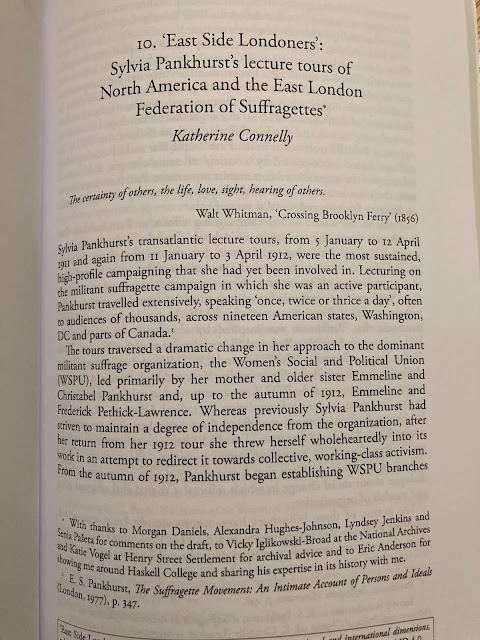 |
| The first page of my chapter in The Politics of Women's Suffrage |
Wednesday, November 17, 2021
Suffragette City event tomorrow!

Really looking forward to this event tomorrow where I'll be speaking alongside legends Rachel Holmes, author of the brilliant new biography Sylvia Pankhurst: Natural Born Rebel, and East London MP Apsana Begum.
We will be walking a few of the sites where Sylvia Pankhurst and the East London Federation of Suffragettes campaigned, organised and made history. Then we'll be speaking about working-class women's history and what we can learn from them in the cafe right next door to where the East London suffragettes used to meet! For those who can't get tickets, the event is going to be streamed.
More details here.
Saturday, November 13, 2021
Review of EMMELINE, The Cockpit Theatre
This review was originally written for The Reviews Hub.
 |
| Photographer: Marisa Knight |
Writer: Beatrice Hyde
Director: Anastasia Revi
This play about events
over a hundred years ago is a play for right now.
Beatrice Hyde’s debut tells
the extraordinary story of the militant suffragette campaign and its devastating
personal consequences for the Pankhurst family.
The imperious Emmeline Pankhurst
(Georgie Rhys), once evocatively described by the feminist writer Rebecca West
as a ‘reed of steel’, is first encountered as a reforming Poor Law Guardian
championing the cause of poor women locked up in a workhouse. Recently widowed,
Emmeline is spurred to act when the local Independent Labour Party erect a hall
in her husband’s name – and then bar women from entering.
Emmeline founds the
Women’s Social and Political Union (WSPU) to fight with ‘deeds not words’ for
votes for women, and her three daughters eagerly enlist as activists in the
cause. The eldest, Christabel, is her mother’s indulged favourite, the middle
daughter, Sylvia, is the romantic artist, while the youngest Adela strives for
attention amongst the other more charismatic Pankhursts.
Government
intransigence results in the WSPU escalating its militant tactics, hauntingly
depicted in this performance. Imprisoned suffragettes place birdcages over their
heads, simultaneously evoking the claustrophobia of the cells and a classic
nineteenth century metaphor for women’s oppression (“She’s Only a Bird in a
Gilded Cage”). In the background, the cast incant lyrics written by a
suffragette imprisoned in Holloway.
Some of the most chilling scenes are those
depicting police violence against the suffragettes. Watching this after Sarah
Everard, Nicole Smallman and Bibaa Henry, the suffragette struggle suddenly
feels very close and unfinished. This is no longer a play about the past, but
about the urgent need for women’s equality today. The lyrics to another
suffragette song performed by the cast remind us: “The vote in itself is just
nothing, / ‘Tis only a means to an end. / Look round you – look under the
surface, / And see what we’re seeking to mend.”
At the heart of the play is the
fraught relationship between Emmeline and Sylvia Pankhurst. It shows in detail
how the failure to win a speedy victory posed dilemmas for them about their
loyalty to their ideals and family. Emmeline responds to these pressures by
abandoning her socialist politics, endorsing proposals to enfranchise a wealthy
minority of women. She becomes increasingly autocratic, demanding absolute
loyalty from a relatively small group of militant activists.
It is Sylvia
Pankhurst (played earnestly by Charlie Hansen), who appears in the most
sympathetic light as she struggles to navigate her loyalty to her mother and the
women’s cause on the one hand and her commitment to working-class emancipation
and her love for the married Labour leader Keir Hardie on the other. In place of
an elitist struggle, Sylvia calls for a democratic mass movement – for which she
pays a painful personal price.
Given the play’s focus and Sylvia’s call to make
working-class people agents of change it is surprising that her breakaway
campaign in East London is only alluded to and not dramatized beyond a few
awkward crowd scenes. That Sylvia starved herself on the steps of the Houses of
Parliament and nearly achieved a breakthrough in negotiating with the
government, forcing the Prime Minster to meet working-class East Londoners face
to face, is surely important evidence that her alternative, more radical
strategy could have been effective – and it would have made good theatre.
In
general, the play is overly narrative: too much is told when it would have been
more effective to show. But no one will leave the theatre without feeling that
we can better confront the injustices of today with the inspiration of the
suffragettes in the past.
Runs until 14 November 2021

Saturday, August 7, 2021
Two Sylvia Pankhurst biographers on revolutionary women's history
Last month I had the great pleasure to join Rachel Holmes, author of the magnificent Sylvia Pankhurst: Natural Born Rebel, in a discussion of women's history at Counterfire's 'Revolution!' festival. Here we explained why the struggle for women's liberation is a necessarily revolutionary struggle.
You can find the other excellent talks from the Festival - including discussions of Palestine, Fred Hampton and revolutionary theory - on the Counterfire website. You can find my review of Rachel Holmes' biography here.
Wednesday, May 5, 2021
New research! How Chicago shaped the East London suffragettes
Happy Birthday Sylvia Pankhurst! In honour of the occasion, I am delighted to be able to share a new piece of research published in Chicago History, the publication of the wonderful Chicago History Museum. You can access it here.
In it, I show how Pankhurst's support for the striking garment workers in Chicago led to her forging important friendships with labour activists including the novelist Miles Franklin and Zelie Emerson - who later helped establish the East London Federation of Suffragettes. I share some facsinating stories about Emerson, who played a crucial role in the garment strike, that shed some light on this often overlooked, but immensely interesting, individual - including her intervention in a husband and wife's quarrel over a "votes for women" banner on their house!
The piece has been lavishly illustrated, which really brings these stories to life. Huge thanks to Chicago History and the Museum for kindly granting me permission to share this on my blog.
I hope that this is enjoyable to read as it was to research and write. Any comments welcome. Watch this space for more research on Emerson!
 Image of Zelie Emerson reconcilling William Murray to the banner on his house, from Chicago Tribune, 4 April 1912.

Tuesday, May 4, 2021
Video: Talk on Sylvia Pankhurst in America for Socialist History Society
Warm and comradely thanks to the Socialist History Society for inviting me to talk about Sylvia Pankhurst in America and for making the film of the talk available online. You can watch it here:
Saturday, April 10, 2021
Upcoming talk!
After a year of lockdown, and consequently few opportunities to have meetings and events, I am delighted to be able to announce an upcoming talk about Sylvia Pankhurst and her travels in America hosted by the lovely Socialist History Society on 15 April at 6.30pm.
The event is of course online and you need to sign up in advance here. Attendance at the event will allow you to buy Sylvia Pankhurst: Suffragette, Socialist and Scourge of Empire and A Suffragette in America at a 30% discount.


Tuesday, October 27, 2020
Pedestals: Reflections on Sylvia Pankhurst, the Hermitage and the Politics of Historical Monuments
I stood looking at the empty
plinth in the baking Baltimore sun. 'There is nothing in the world so invisible
as a monument', Morgan and I had quoted Robert Musil's words to our students
only a few weeks before in London as we looked at which slave owners, overseers
of massacres and sworn enemies of democracy get away with being commemorated
there.
 |
| The empty plinth, Baltimore, 2017 (all photos my own). |
But there's nothing so visible as the vandalised statue or empty
plinth. It reminds us that history is contested - quite literally from below.
The Black Lives Matter movement protested at the presence of Confederate
statues. Some were pulled down, vandalised. In Baltimore, however, the decision
had been taken to remove them in the middle of the night. History would not be
contested here - it would be swiftly rewritten.
 |
| Baltimore, 2017 |
History is written, we are told, by the victors. So how come there
are statues to the Confederacy, the losing side in the American Civil
War?
The statues, though, don't date from the Civil War - they date
from the era of Jim Crow and the KKK. These monuments weren't about the Civil
War, they proclaimed the victory of white supremacy and terror.
This year, Black Lives Matter has
proved as urgent a movement as ever and one that resonates across the globe.
And in Britain the hated statue of Edward Colston, who made enormous profits
from slavery in the eighteenth century, was torn down by a huge crowd and
thrown in Bristol’s dock.
In light of these events, I offer
these thoughts on my visit to The Hermitage as a historian undertaking research
in the summer of 2018, following in the thoughts and footsteps of lifelong
anti-racist Sylvia Pankhurst, as a small contribution to the discussion about
the politics of historical monuments and present day injustice.
When I say ‘footsteps’, that’s
not strictly true. On 14 February 1912, the day she arrived in Nashville,
Tennessee, Sylvia Pankhurst was driven to The Hermitage – the former home of
Andrew Jackson, the seventh president of the United States. It is now, as in
1912, a tourist attraction.
 |
| The Hermitage, tourist attraction. |
Morgan and I are not drivers
(discussed in my Railroads post) and we naively thought we’d get to this
tourist attraction by public transport. The bus was an underused service, there
was only one other passenger and they didn’t appear to know where they were.
The Hermitage stop was nowhere
near The Hermitage to which, it was now clear, there was no pedestrian access. We
trudged alongside dirt tracks up a six lane motorway under the blaring sun.
Finally, seeing the signs to The
Hermitage, we ran across that motorway. It was a ridiculous thing to do, but
the whole situation was ridiculous.
We found ourselves at the
beginning of a long, meandering road, the house nowhere in sight. And that’s
because The Hermitage is a one thousand acre plantation. The picking of cotton
by enslaved people on this huge piece of land was the source of Andrew Jackson’s
wealth.
It would take you a very long
time to get away from here on foot.
 |
| A railroad crossing on the plantation, which provides a sense of scale. |
Sylvia Pankhurst was probably
taken here by local suffragists; the Jackson home was first maintained as an
attraction by women supporters. They were perhaps the same women who told
Sylvia not to speak at Nashville’s Fisk University to an audience of black
students, perhaps those that Sylvia remembered ‘talk glibly of the “slavery
days” as they site behind the Negro coachman, or are waited on at table by the
Negro women servants’ (p.156).
I had read Sylvia’s description
of The Hermitage before I saw it for myself. It seemed little had changed.
There was the ‘row of massive fluted columns of white stone along the front’(p.157).
 |
| The Hermitage, just as Pankhurst described it in 1912. |
In the entrance hall our first
guide, a white man in nineteenth century costume, painfully, offensively
imitated the black woman housekeeper he imagined would have welcomed us during
the ‘slavery days’.
He showed off the wallpaper
depicting mythological scenes, especially ordered by the Jacksons from Paris. I
could hear Sylvia whispering in my ear:
“The
walls of the entrance hall are covered with a hideous hand-painted paper,
specially procured from Paris in General Jackson’s time, which shows
innumerable little six inch gods and goddesses passing through a series of
meaningless adventures. It seems impossible that nineteenth century Paris could
ever have produced anything more ugly.” (p.157)
It was all just as she had
described, including the four post beds so far raised above the floor that
beside them are ‘the steps by which the family were obliged to climb up to them
at night’ (p.157).
These people even slept on
pedestals. The house slaves, we were told, slept on the floor.
We followed Sylvia through the
stuffy rooms to the back porch where, like her, we saw ‘still standing in a
row, are the cabins in which the slaves were housed’ (p.158).
 |
| The slave huts at The Hermitage, also just as Pankhurst described in 1912. |
This is in the home of the man
The Hermitage unashamedly celebrates today as ‘The People’s President’.
The museum attached to the house
insists that Jackson did ‘good’ and ‘bad’ – the overriding message being that
we cannot allow the ‘bad’ to discount the ‘good’. It is a message that the
President and CEO of The Hermitage reiterated in response to the Black Lives
Matter movement this year: “Andrew Jackson was a complex man who, like many
U.S. presidents, was far from perfect” (15 July 2020).
Or, as one commentator on a
Hermitage museum film told us, we have all done good and bad things.
It’s easy to see how this
argument is persuasive – because we have all done good and bad things. We can
all relate to that. And who among us would agree that it’s fair that our worst misdemeanours
should cancel out everything decent we’ve ever done?
But there’s a cunning sleight of
hand going on here. This is not the same as finding out that a good president
was a bit of a bully at school.
Jackson was a militarist and a
populist, presenting himself as on the side of ‘the people’ against the elites –
something uncritically repeated by The Hermitage today: “The People’s President”.
But which people? Not black
people. Not those enlisted soldiers who mutinied against his leadership in the
Creek War. And not Native American people.
Howard Zinn described Jackson as ‘the
most aggressive enemy of the Indians in early American history’ (Zinn, A People’s History of the United States,
New York: Harper Perennial Modern Classics, 2015, p.127). As president, he was
responsible for the devastating forced removal of Native Americans.
Earlier in his career, in the war
for territory occupied by the Creek Indians, Jackson expanded the American
nation into parts of Alabama, Florida, Tennessee, Georgia, Mississippi,
Kentucky and North Carolina.
His policy of selling off the
land he seized expanded capitalist ownership and undermined the unity of Native
American resistance. Huge tracts of seized land made way for new plantations
tilled by enslaved black people to make huge profits for white plantation
owners – like himself.
And this is why it is so clumsy to
say that criticisms of the monuments to slave owners seek to erase history. Millions
of people’s histories were forcibly erased and these monuments perpetuate the
myths propagated by those who erased them.
The Hermitage now purports to
tell the stories of both the president and his slaves. But how can this claim
upon balance be anything but one-sided when the president is the celebrated
subject? It denies the fundamental antagonism in the relationship. Shouldn’t
The Hermitage be a site of mourning, not celebration?
The Hermitage’s self-serving and
simplistic ‘good’ and ‘bad’ dichotomy is misleading because it insists that
they were separate. The ‘bad’ was not an aberration; it was integral to the
creation of modern America. As the Black Lives Matter movement revealed, it’s
not the past we are seeking to change, but the present.
Friday, October 9, 2020
Congratulations to Rachel Holmes on the publication of 'Sylvia Pankhurst: Natural Born Rebel'

"When she wrote her memoir of the suffragette movement,
Sylvia Pankhurst explained:
My desire has been to
introduce the actors in the drama as living beings; to show the striving,
suffering, hugely hopeful human entity behind the pageantry, the rhetoric and
the turbulence.[i]
Pankhurst’s vivid, detailed and human account, in
scale and tone like a nineteenth-century novel filled with memorable characters
and dramatic stories, became the defining history of that movement; the basis,
for example, for the hugely influential 1970s TV series Shoulder to Shoulder that introduced a new generation to the
suffragettes.
Rachel Holmes has achieved a similar feat in her
monumental biography of Sylvia Pankhurst.
Where other biographies have focussed on a particular part of
Pankhurst’s huge contribution to social movements in the twentieth century
(Barbara Winslow’s Sylvia Pankhurst:
Sexual Politics and Political Activism and Mary Davis’ Sylvia Pankhurst: A Life in Radical Politics), or have written
shorter accounts (Shirley Harrison’s Sylvia
Pankhurst: A Crusading Life or my own Sylvia
Pankhurst: Suffragette, Socialist and Scourge of Empire), Rachel Holmes’
book matches the scale, ambition and artistic spirit of her subject’s own
writing.
If Pankhurst had thought about what her biography
should look like, I think perhaps she would have hoped for one like this."
You can read the rest of my rest of my review of Rachel Holmes' new biography of Sylvia Pankhurst on Counterfire. Sylvia Pankhurst: Natural Born Rebel is out now and published by Bloomsbury.
Tuesday, July 7, 2020
Great review in Labour/Le Travail
"The result is an extremely valuable and enlightening picture of Sylvia Pankhurst's changing political ideas, as well as revealing snapshots of the American women's movement and U.S. labouring and social life. Connelly's extended introduction provides an excellent picture of the context framing Sylvia's travel, including the variegated British and American suffrage movements that she interacted with."
Thanks to Professor Joan Sangster, in the Gender and Women's Studies department at Trent University, Canada, for this enthusiastic review of A Suffragette in America in Labour/Le Travail, the journal of Canadian Labour Studies.
Two substantial extracts of the review are available here and here, the full text is available for those with login access to Project Muse or, even better, subscribe to the Labour/Le Travail and support a publication dedicated to working-class history.
Thanks to Professor Joan Sangster, in the Gender and Women's Studies department at Trent University, Canada, for this enthusiastic review of A Suffragette in America in Labour/Le Travail, the journal of Canadian Labour Studies.
Two substantial extracts of the review are available here and here, the full text is available for those with login access to Project Muse or, even better, subscribe to the Labour/Le Travail and support a publication dedicated to working-class history.
 |
| Cover of the previous edition of Labour/Le Travail. |
Monday, June 29, 2020
Labour History Podcast on Sylvia Pankhurst
I was delighted to join Paul T. Simpson to discuss Sylvia Pankhurst and why she remains relevant and inspirational today on his excellent Labour History Podcast.
You can listen to the interview here.
You can listen to the interview here.
 |
| Radical broadcasting! |
Tuesday, June 23, 2020
New Short Documentary: 'Passionate Pankhursts' at the Smith Opera House, Geneva New York
Last year I took A Suffragette in America to the beautiful Smith Opera House in Geneva, New York State and was kindly given a guided tour of the Smith and Geneva's connections to suffrage history by Chris Woodworth. It was magical tour I'll never forget and now you too can share this experience in the 10th episode of Chris' documentary series 'Smith Opera House Ghost Light Tours: Passionate Pankhursts' available below.
You'll find out about why both Emmeline and Sylvia Pankhurst came to lecture at the Smith, the suffragists they met and the differences between the the politics of these two Pankhursts. You'll also find out about how it was easier for Sylvia Pankhurst to get to Geneva in 1911 than it was for me in 2019!
I wrote about the whole experience and discovering the history of suffrage and anti-slavery history in upstate New York in the 'Railroads' entry on this blog. I am really honoured that Chris has included parts of that entry and quoted from A Suffragette in America in her documentary.
You'll find out about why both Emmeline and Sylvia Pankhurst came to lecture at the Smith, the suffragists they met and the differences between the the politics of these two Pankhursts. You'll also find out about how it was easier for Sylvia Pankhurst to get to Geneva in 1911 than it was for me in 2019!
I wrote about the whole experience and discovering the history of suffrage and anti-slavery history in upstate New York in the 'Railroads' entry on this blog. I am really honoured that Chris has included parts of that entry and quoted from A Suffragette in America in her documentary.
 |
| Holding Sylvia Pankhurst's American book outside the Smith Opera House last year. Photo: Chris Woodworth. |
Subscribe to:
Posts (Atom)
-
 Sylvia Pankhurst was reliant upon trains for her tour of North America. The triumph of the car and the oil industry since would render it...
 -
 Just days before she left for America for the first time, Sylvia Pankhurst was hit by a devastating tragedy. Today, I set out with my part...
 -
This is the transcript of a paper I was lucky enough to be able to present at the Transatlantic Women's Networks Conference: Cultural En...
-
 Yesterday I posted my review of Sylvia , a musical currently playing at The Old Vic, about the life of Sylvia Pankhurst. But there's mo...
 -
 Really looking forward to talking about Sylvia Pankhurst tomorrow. Details of how to join the discussion below:
